
Things to do in Interlaken, Switzerland: Winter & Summer tips
Switzerland might be the most beautiful part of Europe and the greater Interlaken area is probably the most beautiful part of Switzerland. When people ask me where to go in Switzerland I always give the Interlaken area as the first answer, but it’s a bit more complicated than that.
Honestly, it’s the Lauterbrunnen Valley, which is a short train ride from Interlaken, where the best views and sights are to be found. Below are my recommendations for what to do in Interlaken with an emphasis on the top sights in the Lauterbrunnen Valley. I basically have them in order from best to second best and on down, with several great options and even advice on where to eat in Interlaken near the bottom.
Is Interlaken worth visiting? A surprising answer
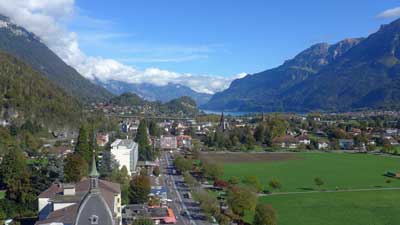 This may seem like a strange question considering this article is all about what to do in Interlaken, but it’s actually an interesting one. Interlaken is a small and very touristy town that has been a touristy town for at least 200 years or so. You’ll be changing trains in Interlaken itself at the very least, and when you do that it’s worth at least walking around the town a bit.
In fact, Interlaken has two main train stations, Interlaken West and Interlaken Ost (east), and the main road connecting them is about a mile long (1.6 KM) so it’s quite a nice walk past dozens of hotels, restaurants, shops, and a huge park that we will discuss later. But aside from that the best things to do in Interlaken are mostly in the nearby Lauterbrunnen Valley, which is about 20 minutes away by train from the Interlaken Ost station. We will discuss that more below. You can compare this with the things to do in Lucerne to see which place looks more interesting if you haven’t got much time.
Things to do NEAR Interlaken are much better
If you’ve got only 2 or 3 days to explore this area I’d recommend a short city tour like mentioned above, and perhaps one or two of the things lower on the list below, but I’d focus most of my attention on the Lauterbrunnen Valley, which is one of the most beautiful areas on the planet.
Most of the absolute best attractions and things to do are in the Lauterbrunnen Valley and I highly recommend staying in the Lauterbrunnen Valley as well for the same reason. I discuss it in detail in this article about where to stay in Interlaken and the Lauterbrunnen Valley, but the short version is that there are a bunch of small (many car-free) villages on the sides of the mountains that are a million times better and more memorable than staying in one of the hotels near the Interlaken train stations.
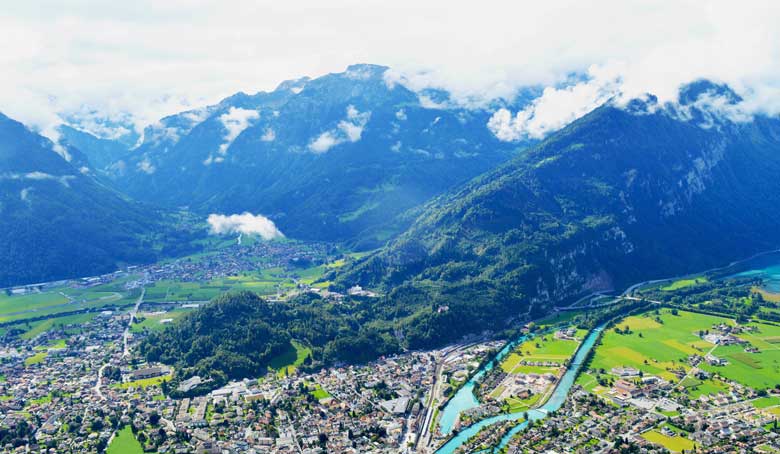
What to do in Interlaken for one day
 With so many people wondering where to go in Switzerland and the top answer is usually the Interlaken area, I get a lot of questions about what to do if you’ve only got one or maybe two days. To help answer that I’ve written my list of recommendations in order from most amazing to worth doing if you have time.
In other words, if you only have one day in the Interlaken area I would pick one or maybe two things from the list below, and hopefully from the first few entries if you can afford them. The top two things aren’t really cheap, but they are going to be the absolute highlight of your trip if you can work them into your itinerary.
Best things to do in or near Interlaken
The list below contains all of my top choices of things to do in the greater Interlaken area in order from best to great to good and on down. If you can only do one or two things I recommend starting at the top of the list.
Jungfraujoch Railway and Eiger Express
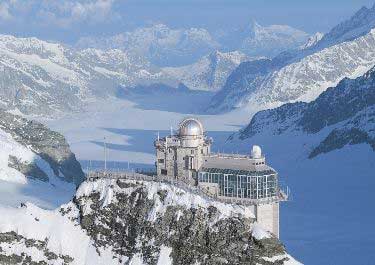 The most famous and most memorable attraction in the Interlaken area is the Jungfraujoch, which is the tourist railway that goes up to the highest train station in Europe. It’s also the most expensive of the attractions, but you should be able to get 50% off and that makes it easily worth it. The peak is 3,454 meters (11,332 feet) above sea level and there is snow up there every day of the year.
The most common way to get there is by the slow train and the roundtrip journey usually takes 5 to 6 hours from the Interlaken Ost train station. As of 2020 there is a new cable car called the Eiger Express that provides even more spectacular views for part of the trip and it cuts about 45 minutes off the journey up as you ride in new gondola lift for part of the ride instead of the slow train the whole way.
There are multiple places you can start the journey and even more configurations of tickets and combinations of segments, but the main thing to know is that this is considered the premiere mountaintop attraction in all of Switzerland and you are going to want to do it if at all possible.
The full cost is about CHF130 (about US$140) round trip, and a bit more if you include the Eiger Express, but you can get a 50% discount if you’ve got the Swiss Half Fare Card or a 25% discount if you have a Swiss Travel Pass. You SHOULD have one of those as it will save a fortune on your whole trip and you can find out more in our discussion of the Swiss Travel Pass in general.
One other thing that is important to know before you do much planning is that the Swiss Alps mountaintops can be foggy or cloudy any day of the year. In fact, the summer is the rainy season (although not much to worry about) and the Jungfrau train station might be shrouded in fog or clouds even in July.
It’s important to take this into account and make sure you book your journey when you know it’s going to be clear up there, or have some flexibility in case you have to reschedule on the day. It’s often clear in the morning and foggy in the afternoon, or sometimes the other way around, but it’s somewhat rare to be foggy all day for days at a time.
Schilthorn Cable car and restaurant
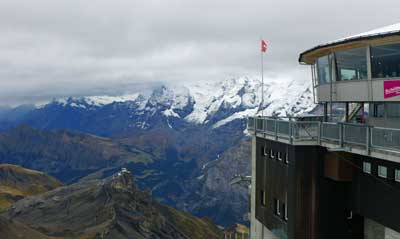 On the other side of the Lauterbrunnen Valley, you’ll find arguably the second most popular attraction in the area and that is the cable car going up to the Schilthorn Observation deck and the Piz Gloria revolving restaurant. The trip takes 3 to 4 hours if you are starting in Interlaken itself, but of course if you have a meal or visit the James Bond attraction (included in your ticket price) it can take longer.
This is a long string of cable cars (gondolas holding about 80 people each) going up from Stechelberg (near the Lauterbrunnen train station) up to the top in about an hour. It’s a really fun and amazing experience and the views at the top are unforgettable as well. Similar to the last part of the Jungfraujoch discussion just above, it can be foggy or cloudy in Schilthorn any day of the year, so you have to take that into account.
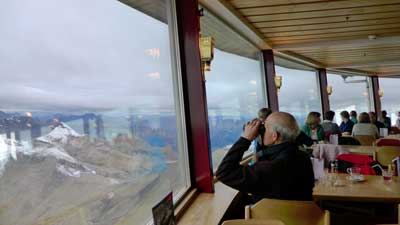 Ticket prices are about CHF108 (US$120) per adult, but again, you should have a Half Fare Card or a Swiss Travel Pass and both of those will offer 50% off those prices, and it’s easily worth it in that case. The food in the restaurant, which does a full revolution every hour, is quite good and is priced similarly to restaurants in Interlaken, so I’d plan on having lunch or at least a drink while you are visiting.
The other (unfortunately complicated) thing to know about is the cable car system used to be closed for maintenance from mid October to early December each year, as this is also the slow period in the area before the snow falls. In 2024 it’s closing in mid October and staying closed until mid March, 2025, when a new section of the cable car will open. From then on the plan is for it to be open every day of the year.
Free, self-guided Walking tour of Mürren and Gimmelwald
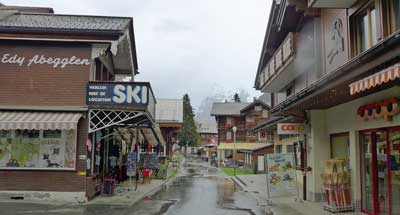 At least until mid October, 2024, the Schilthorn cable car stops in the tiny village of Gimmelwald and then you walk across the platform to board another cable car up to the larger village of Mürren. After that the Gimmelwald stop may be eliminated, at least for some people. But until then I highly recommend doing a free walking tour of both villages on your way down on the Schilthorn cable car.
When you come down from Schilthorn you’ll have two cable car sections that last about 40 minutes total and then you’ll stop again in Mürren. If you disembark there you can walk around Mürren, which is a stunning little village with skiing in winter as well, and then walk down an easy path about 30 minutes to reach the much smaller village of Gimmelwald.
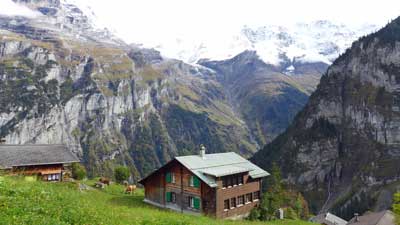 Gimmelwald literally has about 130 residents and it’s basically about 30 or 40 small farms with plenty of Alpine cows, and a few small hotels and a shop or two. It’s the most quaint place on earth and you’ll never forget walking through, especially if the weather is nice. In fact, I highly recommend staying overnight there and that is discussed in detail in my article about where to stay in the Lauterbrunnen Valley. Even if the hotels and hostel are sold out, I highly recommend the walk.
At the end of the path is the cable car station that takes you back down the mountain. It’s impossible to get lost because it’s just the one path and it’s all obvious when you are there. The cable car runs every 30 minutes and you can use your same ticket for that last leg.
Lauterbrunnen Valley and waterfall
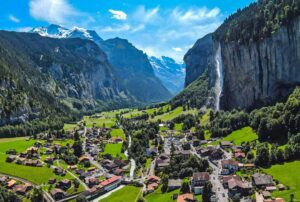 As popular as Interlaken itself seems to be, the real attraction in the area is the absolutely stunning Lauterbrunnen Valley, as pictured above. Jungfrau is on one side and Schilthorn is on the other, but really the whole place is just beautiful and amazing.
You’ll arrive by taking the 20-minute train ride from Interlaken Ost to Lauterbrunnen and once there you are in the small village of Lauterbrunnen and surrounded by mountains on three sides. There are countless hikes and places where you can rent bikes or other vehicles to explore a bit on your own.
If you are going up the Schilthorn Cable Car (mentioned above) you’ll head from the train outside the small station and just across the street there will be a bus waiting for passengers heading to Schilthorn. You can buy a ticket online or in Interlaken that covers the train, the bus, and all of the cable cars up the mountain in one ticket.
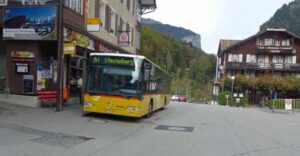 The bus will soon pass the Staubbachfall Waterfall and you’ll have a pretty good chance to see it and take photos on the right side of the bus. Or you can just walk a few hundred meters from the train station and you’ll be able to get much closer and take even better photos. Again, this is one of the most beautiful areas in Europe and if the weather is good it’s ideal for random hiking or following one of the many paths.
It’s hard to do justice to it in an article like this, but you’ll be very pleased if you visit and it’s basically free. Just research the Lauterbrunnen Valley to find things you can do within walking distance from the small village of Lauterbrunnen and its train station.
Specific things to do in the Interlaken area in summer: Hiking and cable cars
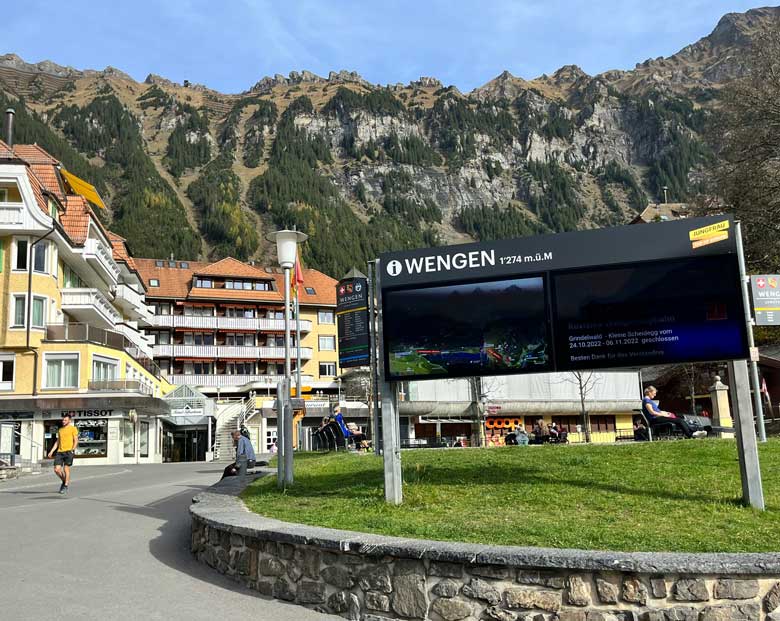
It would take an article about ten times this long to really convey all of the information I’d like to, but the short and helpful version is that there is plenty to do and see in the Lauterbrunnen Valley as described above, and there are also 5 or 6 small villages on the sides of the mountains above that are reachable by train, cable car, or sometimes both.
The hiking season is basically April through mid October although you can usually hike well into November. The snow typically starts piling up by early December and from then through the end of March it’s snow and ski season instead, which will be covered below. Many hotels and restaurants in the area are closed from mid October through the end of November, so that is another thing to be aware of.
There are cable cars (the ones that go up to Schilthorn) going up to Gimmelwald and Mürren on the west side of the valley, and trains and cable cars going up to Wengen and Grindelwald on the east side. There’s another shorter cable car that is a short walk from the train station in Wengen that takes you up to a beautiful viewpoint that is popular with hikers. You can hike around and then hike down or take a train down if you prefer.
Many of the hikes in this area are on wide and paved pathways that are easy for just about anyone, and some of the other trails require a bit of footwork that put them more in the intermediate camp. There’s plenty of information online about the different hikes and the different skill levels required, but overall there are plenty of options for just about anyone.
Specific things to do in the Interlaken area in winter: Skiing and snow activities
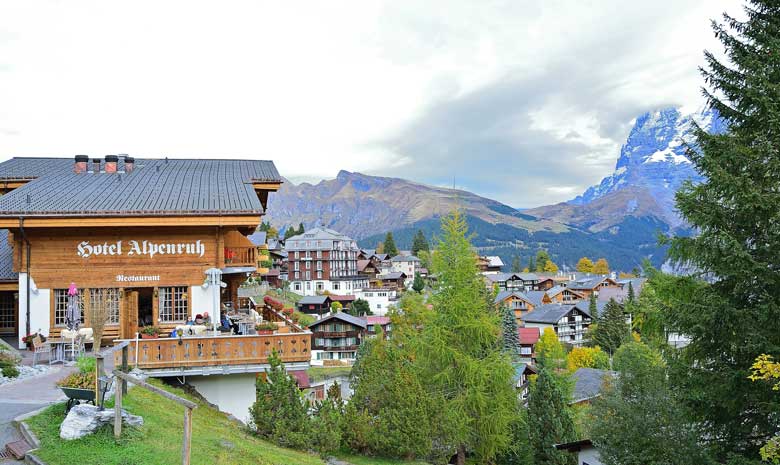
As discussed just above, the snow season in these mountains typically runs from the beginning of December through the end of March. Needless to say, in this era it has become a bit less predictable, but still the higher you go the more chance of a proper bed of snow. And if you go all the way up to Jungfraujoch there is snow all year round.
There are popular ski lifts on both sides of the valley, with several in Mürren and even more in Grindelwald and especially just above Wengen. Just as you’d expect, you can rent skis and boots and all of the other equipment, and the workers will be able to help you in English.
There are even some ski-up hotels in this area and a couple are mentioned in that article linked above about where to stay in Lauterbrunnen.
I’m not the biggest expert on the skiing situation in this area, but I do know that it’s very popular and incredibly scenic. Long story short, if you are coming to this area from December through March then you can research the specifics and you’ll find plenty of resources. But if you are coming any other time of year, then the ski lifts are likely to be closed, although again you can see and touch snow at the top of Jungfraujoch any day of the year.
In winter there is also a popular ice skating rink in Höhematte Park in the center of Interlaken, which is discussed in greater detail below.
Things to do actually within Interlaken itself below
If you want to spend a day or so in Interlaken and are tired or uninterested in the things in the Lauterbrunnen Valley mentioned above, there are three great options. Interlaken itself is kind of cheesy and filled with souvenir shops, but it’s also rather beautiful and quite fun so you could do a lot worse than spending a day or even two here.
Harder Kulm Peak funicular and viewpoint
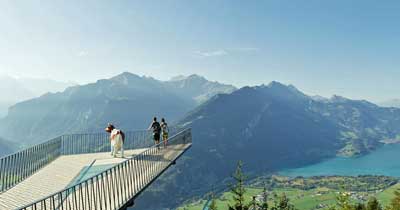 Billing itself as the “Top of Interlaken,” Harder Kulm is the mountain peak just north of the town center and it can be reached by a challenging hike or an easy and scenic funicular railway. The peak is 1,322 meters, compared to the 3,454 meters of the JUngfraujoch train station in the Lauterbrunnen Valley. So it’s not as high or dramatic, but it does look right down onto the scenic Interlaken town center.
The funicular railway goes up from just north of the river a short walk from the Interlaken Ost (east) train station. The ride takes about 10 minutes and costs about US$40 round trip or about US$20 just one way. Again, you will probably have a Half Fare Card so you’ll be paying half that amount so it’s well worth it.
There’s a restaurant on top with indoor and outdoor seating and also surprisingly reasonable prices. This is a popular place for a lunch stop or for a drink or two in the middle of a busy sightseeing day.
Hiking up to Harder Kulm
As long as the weather is decent, you can hike to the Harder Kulm peak and viewpoints. It’s about 4 kilometers (2.5 miles) in each direction. If the weather is dry then the path is safe and fairly easy, but it is considered a challenging hike because you are gaining about 800 meters in elevation from bottom to top.
Those interested in testing their fitness might enjoy the entire loop, which usually takes 2 to 3 hours going up and 1 to 2 hours coming down. For the rest of us it might be better to take the funicular up and then consider hiking back down. This option is a very popular one at peaks all over Europe and it allows you to see the conditions on top before you commit to the walk back down.
Höhematte Park and hang gliders
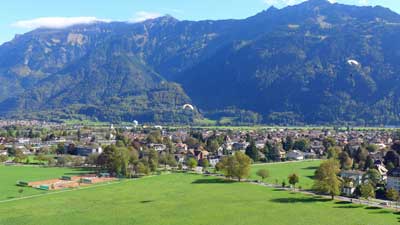
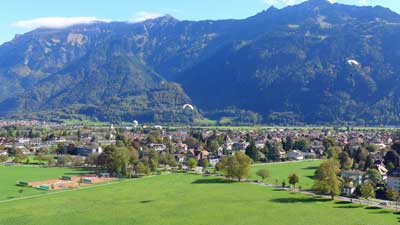 Perhaps a bit surprising, there is a huge open park in the middle of Interlaken, bordering the main road that goes between the two train stations. It’s called Höhematte Park and it’s been there for almost 200 years as the centerpiece of town. It occupies 14 hectares (35 acres) and there are many trails and facilities available. In winter there is a large ice skating rink in the park.
One of the most popular activities is watching the paragliders and hang gliders landing in Höhematte Park, which can be every minute or so during busy times. The colorful kites seem to fill the sky so you’ll be able to take great photos of the park and kites with the mountains in the background.
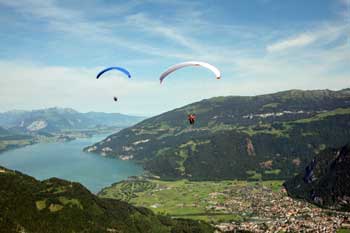 Speaking of paragliders and hang gliders (you can do either), you’ll see posters and advertisements all over town for tandem hang gliders (where you hang from the kite and go fast) and paragliders (where you sit in a seat and go a bit slower). They are popular and many people book well in advance, but if you want to do it you might be able to book the day before or even on the day.
The cost starts at around CHF200 for one tandem glide and they have packages that include extra excursions and meals and such. They all include transportation from your hotel up to the launch area on Beatenberg, which is usually about a 20 minute ride. The flight will last from 10 to 20 minutes, depending on the wind, and it will end in the huge park in the middle of town. Most people love it and since this is Switzerland, you can bet that all of the equipment is the best and the safety procedures are also top-notch.
Cruise on Lake Thun
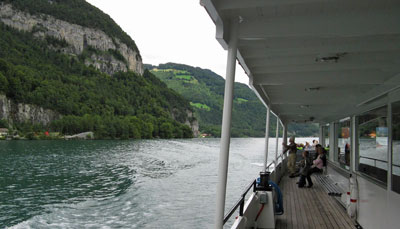 Another easy and scenic option from Interlaken itself is to take a cruise on Lake Thun, which provides more great views of not only the lake, but the mountains surrounding it. You can do a 2-hour cruise all the way to the city of Thun, which is on the opposite edge of the lake, or just a 1-hour cruise that takes you to some scenic areas and then goes back to the dock.
The shorter trips are around CHF 20 while the trip across the whole lake is around CHF50 each way. All of the cruises are covered by the Swiss Travel Pass, so it’s another reason to consider getting one. There are dinner cruises where the cost of the dinner isn’t covered by the passes, but aside from that it’s all covered.
The cruises depart from a small port area just behind the Interlaken West train station. From there you start the cruise in a small canal until you reach the lake itself. I’ve yet to do one of these cruises, but I hear good things about them and I would absolutely do one of them if I had a Swiss Travel Pass
Where to eat in Interlaken
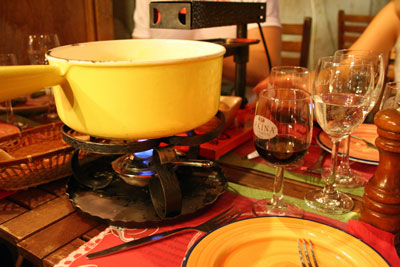 This question frequently comes up so I thought I’d cover it here. You won’t be surprised to learn that Interlaken, as a very touristy town, has no shortage of restaurants. The largest cluster is in the area near and just north of the Interlaken West train station. One thing to be aware of is that pretty much all of the restaurants in Interlaken are weirdly expensive. A main course starts around CHF25 (US$28) and it goes up from there.
The good news is that the food tends to be quite good and filling. You can get fondue or the famous rosti potato dish in many of the traditional restaurants, and there are quite a few international restaurants as well. Interlaken is very popular with tourists from India (it has been the setting of quite a few Bollywood films) and there are a few Indian restaurants in town as well.
If you are looking for something cheaper you do have a few options. There are a few snack bar and fast-food type places in and near the Interlaken West train station where you can get a meal for under CHF20. Or even cheaper there is a full-size supermarket attached to each train station. In Interlaken West it’s a Migros and the Ost station has a Coop, and both are large and popular chains. They sell prepared salads and sandwiches and other similar items that will be under CHF10 per person. Unless you have access to a kitchen at your hotel, this might be the cheapest option in town.